In this weeks reading we had to read a chapter about Dialogic Tools to use in our future classrooms. A Dialogic Tool is defined as an activity, heuristic, assemblage, guide, or other mechanism a teacher uses in planning and practice that helps scaffold students into talking to learn. In basic terms it's a strategy to improve student talking. Using dialogic Tools in your classroom will insure you the teacher ask authentic questions that will create discussion in class, rather then right and wrong questions.
Also in this chapter there is Teacher-Led Tools and Student-Led Tools, both of which I found interesting and relatable as a student.
Some examples of Teacher-Led Tools that I liked were Four Corners and Take A Stand. Both of these strategies are both that I would like to use while practicing. Four Corners will be helpful in the classroom because it will ask students from each corner of their choosing to elaborate on their stances and interpretations. Along with Take A Stand, which is very similar to Four Corners, will help students get up from their seat and choose a side of the room, where they "stand" on the discussion.
There were many Student-Led tools that were mentioned in this chapter. Some that I found that would be practical in my future classroom were Fishbowl, Gallery Walk, Socratic Seminar, and Role-Playing Games. Fishbowl will help students discuss and take notes together and hear the opinions of all students. Gallery Walk will once again get the students up and moving together to see all opinions of certain quotes and questions. They will also be able to write or talk about their opinions of the artifacts. Socratic Seminar is a great lesson for the teacher to step back and let the students run their own lesson. This strategy is a great deal of preparation for the students, but will show their handwork and dedication. Role-Playing games will be a fun and silly experience for the students. When they get to pretend to be talk show hosts or radio callers they will be able to have fun and also learn more with a deep discussion with the author.
Dialogic Tools are extremely important for future classrooms because it helps with deeper understandings from the students. To my knowledge as a student I know that I have always hated just the standard
Sunday, February 22, 2015

Sunday, February 15, 2015
YA Reading #1: Speak by Laurie Halse Anderson
For my Young Adult Literature reading I decided to read Speak by Laurie Halse Anderson. This novel is a National Book Award finalist, and was also recommend to me by two friends who read this book in high school.
 Speak. This is something Melinda Sordino rarely does her freshman year of high school. Melinda is an outsider, all of her friends and even strangers hate her. All because of a party she called the cops on. This novel depicts the reality of what it is like to be in high school, what we all felt during this time. You will soon find out what really happened at that party one August night, and everything will change for Melinda.
This novel is fairly easy read. I honestly read it in one day by taking lots of breaks in between. I would suggest this novel to be read maybe for either 9th or 10th graders.
I would say Speak should be circulated. Anderson's novel is completely relatable to all highschoolers in my opinion, not even just from Melinda's viewpoint. Anderson accurately describes what it is like trying to fit in with certain cliques. "We fall into clans: Jocks, Country Clubbers, Idiot Savants, Cheerleaders, Human Waste, Eurotrash, Future Dascists of America, Big Hair Chix, the Marthas, Suffering Artists, Thespians, Goths, Shredders. I am clanless" (Anderson, 4). I also think that Speak really could show current students to not judge their peers by their exterior. This novel also presents passion through the writing, which will be great for students to absorb.
Three Discussion Questions:
1. In Speak, Melinda says: "It is easier not to say anything. Shut your trap, button your lip, can it. All that crap you hear on TV about communication and expressing feelings is a lie. Nobody really wants to hear what you have to say." Do you agree or disagree with Melinda? What does the end of the novel say about her opinion? Do you think Melinda's outlook changes in the novel? How?
2. Why does Melinda refer to Andy Evans as IT in the beginning of the novel, but then later refers to him by name?
3. What keeps Melinda so silent? What or who is she afraid of?
I really recommend this book to read!
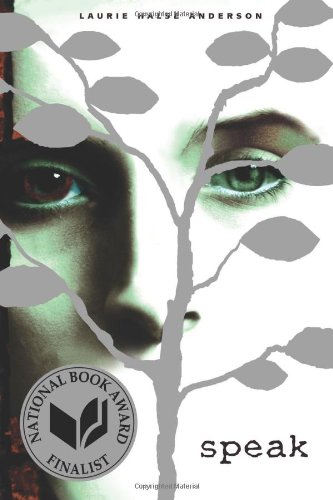 Speak. This is something Melinda Sordino rarely does her freshman year of high school. Melinda is an outsider, all of her friends and even strangers hate her. All because of a party she called the cops on. This novel depicts the reality of what it is like to be in high school, what we all felt during this time. You will soon find out what really happened at that party one August night, and everything will change for Melinda.
This novel is fairly easy read. I honestly read it in one day by taking lots of breaks in between. I would suggest this novel to be read maybe for either 9th or 10th graders.
I would say Speak should be circulated. Anderson's novel is completely relatable to all highschoolers in my opinion, not even just from Melinda's viewpoint. Anderson accurately describes what it is like trying to fit in with certain cliques. "We fall into clans: Jocks, Country Clubbers, Idiot Savants, Cheerleaders, Human Waste, Eurotrash, Future Dascists of America, Big Hair Chix, the Marthas, Suffering Artists, Thespians, Goths, Shredders. I am clanless" (Anderson, 4). I also think that Speak really could show current students to not judge their peers by their exterior. This novel also presents passion through the writing, which will be great for students to absorb.
Three Discussion Questions:
1. In Speak, Melinda says: "It is easier not to say anything. Shut your trap, button your lip, can it. All that crap you hear on TV about communication and expressing feelings is a lie. Nobody really wants to hear what you have to say." Do you agree or disagree with Melinda? What does the end of the novel say about her opinion? Do you think Melinda's outlook changes in the novel? How?
2. Why does Melinda refer to Andy Evans as IT in the beginning of the novel, but then later refers to him by name?
3. What keeps Melinda so silent? What or who is she afraid of?
I really recommend this book to read!
Sunday, February 8, 2015
Text-to-Self Paper: Carlie Harmon
◯◯◯◯◯◯◯◯◯◯◯◯◯◯◯◯◯◯◯◯◯◯◯◯◯◯◯◯◯◯◯◯◯◯◯◯◯◯◯◯◯◯◯◯◯◯◯◯

Upon reading the criteria for this assignment I read that within this blog post we are basically recreating the meaning we felt while reading a certain piece of fiction or poetry. Immediately I thought back to about eleventh grade, when I was about 16 (was that really 5 years ago?!), I was completely obsessed with Tumblr and everyone always posted about this book called The Perks of Being a Wallflower by Stephen Chbosky. At this point in my life I had just moved back to the United States, after living overseas in Okinawa, Japan for four years and I sometimes thought of myself as a wallflower. I definitely was always categorized as the "shy" one at my old high school. So after reading this book, I decided to not be the wallflower, like Charlie.
Senior year at Anoka High School was the best school year I ever had. I made a lot more friends then I've ever had before, I got my first job and was finally making money for myself, and overall
I was completely, utterly, and genuinely happy.
◯◯◯◯◯◯◯◯◯◯◯◯◯◯◯◯◯◯◯◯◯◯◯◯◯◯◯◯◯◯◯◯◯◯◯◯◯◯◯◯◯◯◯◯◯◯◯◯
While reading you'll find out Charlie has a deep secret the ruins his freshman year. I didn't know at the time I was reading this during my junior year, but I soon had a terrible experience that almost ruined my senior year. I had found out that my parents who were married for twenty years were getting a divorce. This really crushed me during this time of my happiness. I thought back to this book actually, and I remembered how Charlie surrounded himself with great people like Sam and Patrick.

◯◯◯◯◯◯◯◯◯◯◯◯◯◯◯◯◯◯◯◯◯◯◯◯◯◯◯◯◯◯◯◯◯◯◯◯◯◯◯◯◯◯◯◯◯◯◯◯
The Perks of Being a Wallflower is a novel in my opinion that many teenagers who are in the in between stage of adulthood and still being a teen should read this book. I know after I read this I no longer felt like I had a childish mind. What I mean by that is I was able to grow up. I remember most of my teenage years I always was concerned of what everyone thought me, so most of the time I didn't spread my wings as far as they could go. I think this book is great for those who need to get over that hump. In the book Charlie writes letters to a friend and throughout he grows up tremendously and so does his reader.
◯◯◯◯◯◯◯◯◯◯◯◯◯◯◯◯◯◯◯◯◯◯◯◯◯◯◯◯◯◯◯◯◯◯◯◯◯◯◯◯◯◯◯◯◯◯◯◯
◯◯◯◯◯◯◯◯◯◯◯◯◯◯◯◯◯◯◯◯◯◯◯◯◯◯◯◯◯◯◯◯◯◯◯◯◯◯◯◯◯◯◯◯◯◯◯◯
Besides all of the personal feelings I was reminded of and the coming of age feeling overall this book reminds you life is short and you shouldn't take anything for granted. Charlie is hospitalized for mental reasons in this book and it made me realize that something that could happen in a matter of five seconds could change your life completely. The quote that stuck with me the most is
"And in that moment, I swear we were infinite." (Chbosky, 39).
◯◯◯◯◯◯◯◯◯◯◯◯◯◯◯◯◯◯◯◯◯◯◯◯◯◯◯◯◯◯◯◯◯◯◯◯◯◯◯◯◯◯◯◯◯◯◯◯
In 2012 of course Hollywood made a theatrical version of this book (like every other great book). Most movies that are portrayed after books usually are so far from good it's ridiculous. I might be biased because I am an avid reader and reading a book makes the feelings ten times stronger. The Perks of Being a Wallflower was different, I mean I loved the book a lot more, but the movies portrayal wasn't half bad. With that, I want to share my favorite scene from the movie. It's the last scene where my favorite quote is also said.
Subscribe to:
Posts (Atom)